
General information
Facts about Kenya
Basic facts
- Name: Republic of Kenya Location: East Africa, bordering Ethiopia, Somalia, Tanzania, Uganda and the Indian Ocean
- Size: Kenya covers a total area of approximately 582,650 km². For comparison, Sweden has an area of roughly 450,295 km². Kenya is approximately 1.3 times the size of Sweden in terms of area.
- Population: Approximately 57.5 million inhabitants in 2025.
- Median age: Approximately 20 years on average
- Population density: Approximately 100 people per km², compared with approximately 24 people per km² in Sweden.
Form of government
- Kenya is a unitary state and a multi-party democracy with a president as head of state and head of government.
- There are two primary levels of government: the national government and 47 county governments, according to the new constitution.
- Official languages: English and Swahili.
Religion
- The dominant religion is Christianity – approximately 85% of the population identify as Christian.
- The second largest religion is Islam, with around 10–11% of the population.
- Other religions include traditional African religions, Hinduism and the Bahá’í faith.
Largest cities & urban centres
Here are some of the largest cities in Kenya and estimates of their populations (may vary depending on the source):
- Nairobi (capital) – approx. 5.8 million inhabitants in 2025.
- Mombasa – approx. 1.55 million inhabitants in 2025.
- Nakuru – approx. 450,000 inhabitants.
- Kisumu – approx. 422,000 inhabitants.
- Eldoret – approx. 476,000 inhabitants.
These cities are important as economic, administrative and transport hubs.
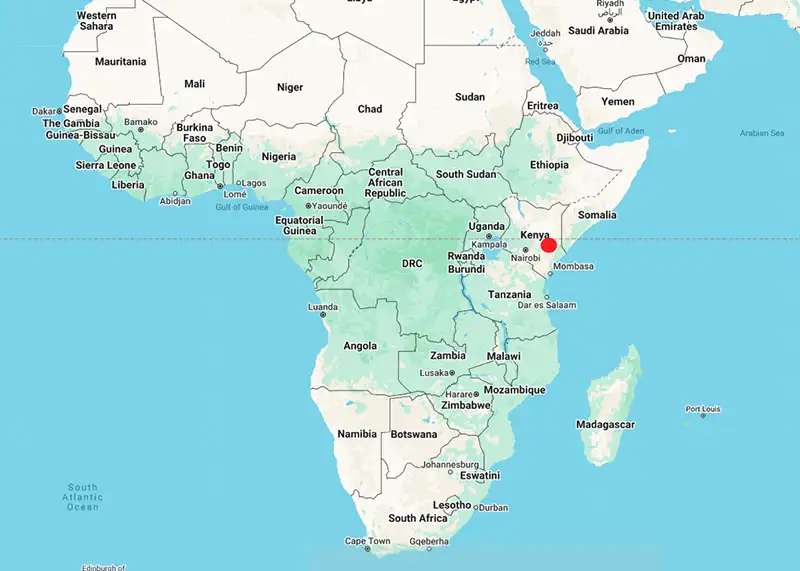
Interesting facts
- Geographical diversity: Kenya has a wide variety of landscapes – from the coastal zone on the Indian Ocean, through highland areas to parts of the Great Rift Valley and mountains such as Mount Kenya (5,199 m), which is Africa’s second-highest peak.
- Agriculture & natural resources: Much of the country consists of agricultural and pastoral areas, alongside arid and semi-arid zones with lower potential. This is relevant from a farming, land-use and natural-resource perspective.
- Young population: A median age of around 20 shows a relatively young population, which can mean dynamism for the labour market, education, and future economic development.
- Urbanisation and infrastructure challenges: Rapid urban growth in cities such as Nairobi creates challenges for housing, transport, and infrastructure.
Sources
Here is a summary of some of the sources used for the information on this page about solar energy, the market and technology.
- International Energy Agency (IEA) – Africa Energy Outlook 2022: data on solar radiation, electricity supply and development in East Africa.
https://www.iea.org/reports/africa-energy-outlook-2022 - GlobalPetrolPrices.com – Current electricity price levels in Kenya and other countries (2025).
https://www.globalpetrolprices.com/Kenya/electricity_prices/ - PV Magazine – Article on global average costs (LCOE) for solar energy in 2023–2024 according to IRENA.
https://www.pv-magazine.com/2024/09/27/global-average-solar-lcoe-stood-at-0-044-kwh-in-2023-says-irena/ - Fortune Business Insights – Report on the growth of the solar energy market in the Middle East and Africa.
https://www.fortunebusinessinsights.com/middle-east-africa-solar-photovoltaic-pv-market-105691 - EnergyTracker Asia – Analysis of the role of solar energy in Kenya and the pace of expansion in the region.
https://energytracker.asia/solar-energy-in-kenya/ - IMARC Group – Market analysis for renewable energy in East Africa with forecasts and investment data.
https://www.imarcgroup.com/east-africa-renewable-energy-market - UN Climate Change (UNFCCC) – Facts about the climate benefits, employment and societal impacts of renewable energy.
https://www.un.org/en/climatechange/raising-ambition/renewable-energy - U.S. Department of Energy – Energy Saver – Explanations of the technical and economic benefits of solar energy.
https://www.energy.gov/energysaver/benefits-residential-solar-electricity - Statkraft – In-depth look at agrivoltaics: how solar panels and agriculture are combined in practice.
https://www.statkraft.com/newsroom/explained/agrivoltaics-combining-solar-panels-and-agriculture/ - Greensolver – Data on profitability and returns (IRR/ROI) for agrivoltaic projects in Europe.
https://greensolver.net/what-profitability-can-be-expected-from-an-agrivoltaic-project/ - Better Globe Forestry – Information about reforestation, climate projects and sustainable forestry in Kenya. https://betterglobeforestry.com/
For more information
Would you like to know more about this unique business concept?
